The Moon
Craters, lunar maria and a sharply defined boundary between light and shadow, especially impressive around the first and last quarter.


Telescope OPTICON Apollo 70F300AZ


A lightweight and easy-to-use refractor telescope that lets the whole family begin exploring the Moon on the very first clear evening.
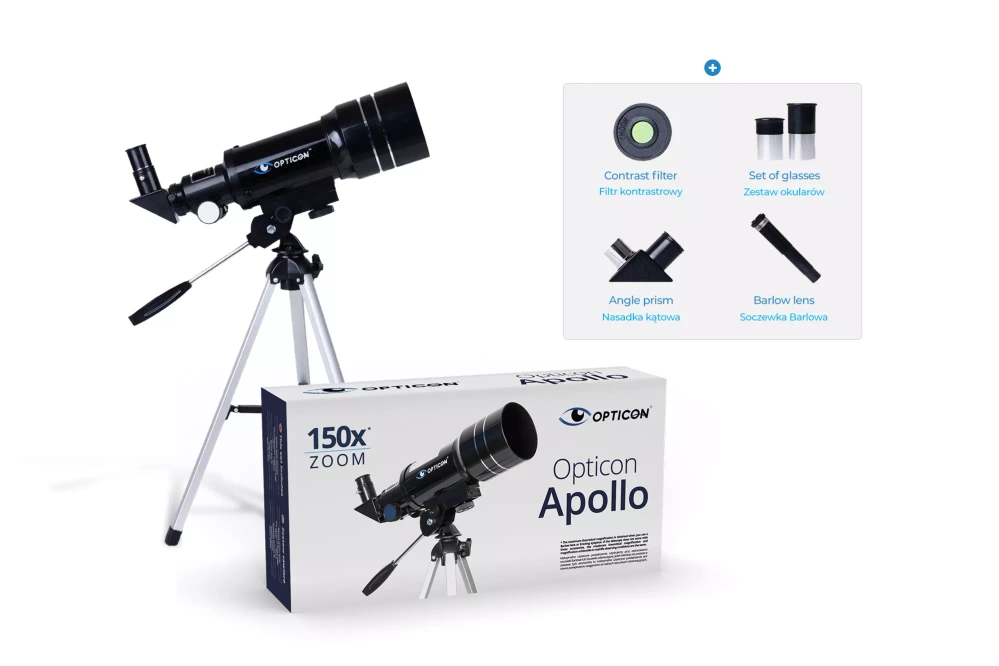
Apollo is designed for beginners and young explorers. Its short optical tube, low weight and intuitive up-down, left-right movement make it easy to begin observing. It is a great choice for viewing the Moon, bright planets, star patterns and distant terrestrial objects.
You will get the best results under steady skies, away from bright lights. The view through the eyepiece is more subtle than space photographs—and that is exactly what makes your first real discovery so memorable.
Craters, lunar maria and a sharply defined boundary between light and shadow, especially impressive around the first and last quarter.
The planet's bright disc and its four largest moons, whose positions change from one night to the next.
The planet's changing phases—similar to the phases of the Moon—best seen when the atmosphere is steady.
The wide field of view is well suited to bright star clusters, star patterns and learning your way around the night sky.

You do not need to understand complex celestial coordinates or align a polar axis. The alt-azimuth mount moves intuitively, much like the head of a standard camera tripod.
At approximately 2 kg, with a short optical tube, the telescope is easy to take on holiday, into the garden or beyond the city lights.
The short focal length makes bright objects easier to find and lets you explore larger areas of the sky.
When correctly set up, the telescope can also be used to observe distant landscapes. Never point it towards the Sun.
Always begin with the H20 mm eyepiece. It provides the brightest image and widest field of view, making your target easier to locate.
The best option for getting started, viewing wide areas of the sky and observing distant landscapes.
A closer view of the Moon and bright planets under favourable observing conditions.
The set's maximum magnification configuration. Its usefulness depends on the weather, the object's altitude and tripod stability; the image will be dimmer.

The OPTICON Apollo 70F300AZ is a lightweight family telescope and an inspiring gift for a young explorer. It is at its best when simplicity, portability and the excitement of first-hand views of the Moon and bright celestial objects matter most.
Warning: never observe the Sun without a certified solar filter securely fitted over the front of the telescope. The stated 150× magnification is achieved by combining the H6 mm eyepiece with the 3× Barlow lens; image quality at this setting depends on observing conditions.